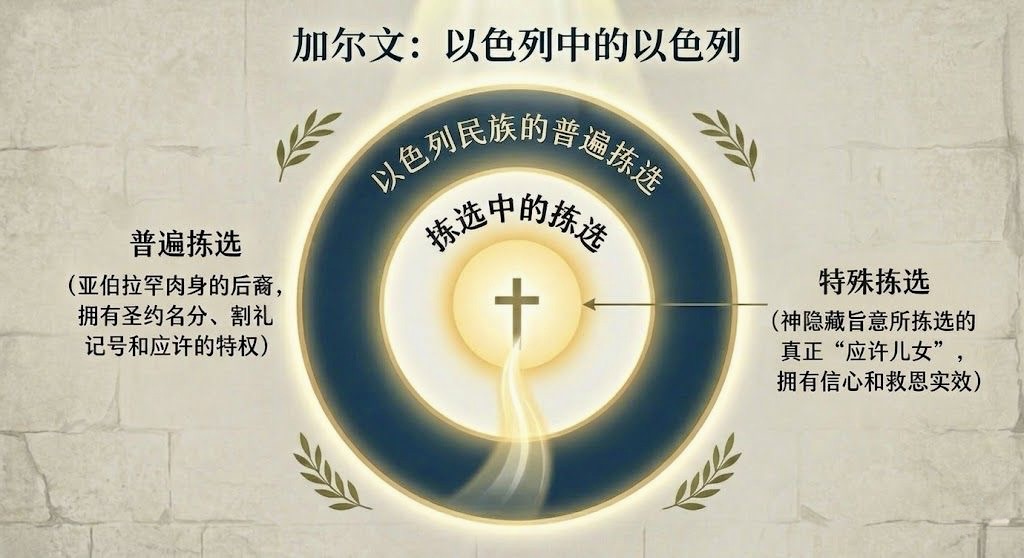
加尔文指出,上帝对以色列的拣选实际上有两个“圈子”。外圈是上帝与整个以色列民族(亚伯拉罕的所有血缘后裔)的普遍拣选。在这个圈子里,所有人名义上都是“约的子孙”,拥有割礼的记号和听闻救恩的特权,这彰显了上帝对一个民族整体的开恩。然而,在这些后裔中,上帝还运用祂隐藏的旨意进行了第二次拣选,形成了一个内圈(即特殊的拣选,或称上帝隐藏的拣选(hidden election))。只有这个内圈里的“应许儿女”或称为“余剩子民”,才拥有真正的信心,并让救恩的应许在生命中产生实效。因此,即使外圈中有人因不信而背弃了上帝,也不代表上帝的应许落空了(罗9:6),因为神真正的主权计划本就是通过这个“圈内有圈”,就是上帝在永恒中特殊拣选信主的子民来承受救恩。
加尔文在评注中首先澄清了一个核心困惑:既然上帝对亚伯拉罕及其后裔许下了永恒的诺言,为何许多犹太人最终却背离了上帝?难道是上帝的应许落空了吗?加尔文指出,问题的关键在于我们如何定义“亚伯拉罕的后裔”。他提出,上帝的拣选实际上存在两个层面:首先是(普遍的拣选),这涵盖了所有肉身生于亚伯拉罕血脉的人。这些人(如以实玛利和以扫)在名义上都属于“约的子孙”,拥有接受割礼和听闻应许的特权,这种地位是上帝白白赐予整个以色列民族的荣耀。
然而,加尔文进一步阐述了第二个更深层的层面,即(特殊的拣选)或称上帝隐藏的拣选(hidden election)。他强调,并非所有拥有亚伯拉罕血统的人都自动成为“应许的儿女”。真正的儿女,是指那些在生命中经历应许之“实效”与“权能”的人,也就是那些拥有真实信心的人。这就解释了为什么有些受过割礼的以色列人最终失落了,因为他们虽然拥有名分(外在的记号),却因不信和背弃,拒绝了这名分所带来的实质益处。
总而言之,加尔文认为上帝的信实并未因以色列人的背叛而动摇。上帝的计划是在庞大的“名义上的选民”中,根据祂主权且隐藏的旨意,选出真正属于祂的“余民”(remnant)。这种区分也同时提醒基督徒:宗教身份、家庭背景或外在仪式(如割礼或洗礼)固然是上帝赐予的恩惠,但唯有圣灵在人心中重生的工作所产生的真信心,才能使人真正承受上帝的救恩。
加尔文罗马书注释(罗9:6)
罗马书 9:6 这不是说神的话落了空。因为从以色列生的不都是以色列人,7 也不因为是亚伯拉罕的後裔就都作他的儿女;…
加尔文:论亚伯拉罕的后裔与应许的子孙
“并不都是……”等等。 这里的论点是:上帝的应许是赐给亚伯拉罕及其后裔的,但这份产业并不无区别地属于每一个后裔。由此可见,即便有人背弃圣约,也不证明上帝的约不再坚定有效。
为了更清楚地说明主是在何种条件下接纳亚伯拉罕的后裔为特作自己的子民,此处必须考虑两点:
第一点:普遍的应许与自然的血缘
上帝赐给亚伯拉罕的救恩应许,属于所有在自然血缘上追溯到他的人;因为这应许是无例外地向所有人发出的。基于这个原因,他们被理所当然地称为**“约的继承人”;在这方面,他们是亚伯拉罕的继任者,或如圣经所称的“应许的儿女”**。
既然主的旨意是要让祂的约在以实玛利和以扫身上受印记,如同在以撒和雅各身上一样,可见他们并没有完全与主隔绝;除非你认为割礼毫无价值,但割礼是根据上帝的命令施行在他们身上的,若轻视割礼便是对上帝的不敬。正如使徒保罗之前所说:“诸约……都是他们的”(罗 9:4),即便他们不信,这些名分依然属于他们;在《使徒行传》3:25 中,彼得也称他们为**“约的子孙”**,因为他们是先知的后裔。
第二点:特殊的选民与应许的实效
**“应许的儿女”**严格来说是指那些在他们身上显出应许权能与实效的人。基于这一点,保罗在此否认亚伯拉罕所有的子孙都是上帝的儿女,虽然主曾与他们立约,因为只有极少数人持守了约中的信心。然而,上帝自己在《以西结书》中见证说,祂将他们整体都视为儿女(结 16:20-21)。
简而言之,当全体人民被称为上帝的产业和特作归祂的子民时,其含义是:他们被主拣选,救恩的应许已向他们发出,并由割礼这一符号所确证。但是,由于许多人因忘恩负义而拒绝了这份名分,从而未能享受其任何益处,因此在应许的成就上,他们之间产生了差异。为了不让人们因应许在许多犹太人身上没有实现而感到奇怪,保罗否认了这些人被列入上帝真正的选民之中。
有些人可能更倾向于这样的表述:“以色列民族普遍的拣选The general election,并不妨碍上帝根据其隐藏的旨意,从他们中间拣选他所喜悦的人。”
当上帝垂顾一个民族并与其立生命之约时,这确实是白白恩典的辉煌范例;但在那仅限于一部分人的“第二次拣选”中,上帝隐藏的恩宠表现得更为明显。
当保罗说“从以色列生的,不都是以色列人”,以及“亚伯拉罕的后裔,不都是儿女”时,他在修辞上运用了一种词义转换(即委婉修辞/παρονομασία)。在每一句的前半部分,他涵盖了整个种族(肉身的后裔);而在后半部分,他仅指那些没有堕落的、真正的子孙。
7. 然而,“从以撒生的,才要称为你的后裔。” 保罗引用这句经文是为了表明:上帝隐藏的拣选(hidden election)胜过(并决定了)其外在的呼召(outward calling)。这种拣选绝非与外在呼召相抵触,相反,它促使了外在呼召的确认与最终成就。
For not all, &c. The statement is,—that the promise was so given to Abraham and to his seed, that the inheritance did not belong to every seed without distinction; it hence follows that the defection of some does not prove that the covenant does not remain firm and valid.
But that it may be more evident on what condition the Lord adopted the posterity of Abraham as a peculiar people to himself, two things are to be here considered. The first is, That the promise of salvation given to Abraham belongs to all who can trace their natural descent to him; for it is offered to all without exception, and for this reason they are rightly called the heirs of the covenant made with Abraham; and in this respect they are his successors, or, as Scripture calls them, the children of the promise. For since it was the Lord’s will that his covenant should be sealed, no less in Ishmael and Esau, than in Isaac and Jacob, it appears that they were not wholly alienated from him; except, it may be, you make no account of the circumcision, which was conferred on them by God’s command; but it cannot be so regarded without dishonour to God. But this belonged to them, according to what the Apostle had said before, “whose are the covenants,” though they were unbelieving; and in Acts 3:25, they are called by Peter, the children of the covenants, because they were the descendants of the Prophets. The second point to be considered is, That the children of the promise are strictly those in whom its power and effect are found. On this account Paul denies here that all the children of Abraham were the children of God, though a covenant had been made with them by the Lord, for few continued in the faith of the covenant; and yet God himself testifies, in the sixth chapter of Ezekiel, that they were all regarded by him as children. In short, when a whole people are called the heritage and the peculiar people of God, what is meant is, that they have been chosen by the Lord, the promise of salvation having been offered them and confirmed by the symbol of circumcision; but as many by their ingratitude reject this adoption, and thus enjoy in no degree its benefits, there arises among them another difference with regard to the fulfilment of the promise. That it might not then appear strange to any one, that this fulfilment of the promise was not evident in many of the Jews, Paul denies that they were included in the true election of God.
Some may prefer such a statement as this,—“The general election of the people of Israel is no hinderance, that God should not from them choose by his hidden counsel those whom he pleases.” It is indeed an illustrious example of gratuitous mercy, when God deigns to make a covenant of life with a nation: but his hidden favour appears more evident in that second election, which is confined to a part only.
But when he says, that all who are of Israel are not Israelites, and that all who are of the seed of Abraham are not children, it is a kind of change in the meaning of words, (παρονομασία); for in the first clause he includes the whole race, in the second he refers only to true sons, who were not become degenerated.
7. But, “In Isaac shall thy seed be called.” Paul mentions this, to show that the hidden election of God overrules the outward calling, and that it is yet by no means inconsistent with it, but, on the contrary, that it tends to its confirmation and completion.
Calvin, J., & Owen, J. (2010). Commentary on the Epistle of Paul the Apostle to the Romans (pp. 344–345). Logos Bible Software.