作者:C.S. 路易士(C.S. Lewis)
书名:《地狱来鸿》(英文原名 The Screwtape Letters,初版 1942 年)
在 C.S. Lewis 的《The Screwtape Letters》(1942,写于第二次世界大战期间)中,沃姆伍德(Wormwood)是一名初级的诱惑恶魔,他是资深恶魔史克鲁泰普(Screwtape)的侄子。整本书的内容都是叔叔写给侄子的信件。Wormwood 的任务是引诱并使特定的人类(the patient)远离神。他因缺乏经验、行事笨拙,经常在信中被叔叔责骂,而叔叔则教导他如何用各种方式欺骗、引诱人类,使他们偏离神。
《第七封书信》的写作背景正处于二战时期,当时英国社会一方面有支持参战的“英国战争努力”(the British war-effort),另一方面也有反战的“和平主义”(pacifism)。Lewis 借由 Screwtape 的口吻指出,基督徒在现实中容易受到这些两极立场的拉扯,有的人倾向和平主义,有的人则倾向支持英国参战。Screwtape 的策略正是要利用这种张力,使基督徒把注意力放在政治立场上,而忽略信仰的真正焦点。
Lewis 借此揭示魔鬼的诡计:让信徒把 Christianity(基督教)误解为某种 Cause(主义或运动)的附属部分,而不是以上帝与福音为中心。通过这种独特的文学方式,Lewis 帮助基督徒从魔鬼的角度反思日常生活背后的属灵争战,从而更加警醒地抵挡诱惑,持守信仰。
《第7封书信》摘录“改写/概括自 C.S. Lewis, Letter VII”
亲爱的沃姆伍德 Wormwood:
……把他(就是那病人 the patient,你负责引诱的人类)推向 Pacifism(和平主义)对我们几乎没有什么好处,因为 the Enemy(上帝)大概会保护他,使他免于一般人加入某个 sect(宗派、小圈子)时常见的负面影响。与其这样,你更好的办法是制造一场突然而混乱的情绪危机,让他因此转向 Patriotism(爱国主义),虽然他的内心会感到不安。像这样的操作我们往往能够成功。但如果他真是我所判断的那种类型的人,那就把他推向 Pacifism(和平主义)吧。
无论病人最终走向 Patriotism(爱国主义)还是 Pacifism(和平主义),你的任务其实都一样:先让他以为这是他信仰中的一个小部分。接着,利用 partisan spirit(党派精神、阵营对立)的影响,让他逐渐慢慢的把这种政治立场当成信仰里最核心重要的部分。最后,在把他慢慢的引导到这种状态:基督教被视为某个 Cause(主义、运动)的一部分,而它的价值在于能为 the British war-effort(英国战争,指二战时期支持英国参战的立场)或 Pacifism(和平主义,指反战、避免参战的立场)提供依据。
你尤其要警惕另一种完全相反的态度:就是病人把所有 temporal affairs(世俗的事务,如政治、社会议题、日常事务)都看作是需要顺服上帝。如果他凡事都在心里先问自己‘在这件事上我如何顺服神?’,那对我们来说就意味着我们完全的失败了。
但如果你能让他把世界当成人生的终极目标,而把信仰只当作实现这个目标的工具,你几乎就已经完全操控了他。至于他追求哪一种世俗目标(无论是政治的、社会的,还是道德的),其实都无关紧要。只要 meetings, pamphlets, policies, movements, causes, crusades(会议、小册子、政策、运动、主义、社会宣传/活动)对他来说比 prayers, sacraments, charity(祷告、圣礼、仁爱)更为重要,他就稳稳的落在我们的阵营里了。而且在这种情况下,他越是显得“religious”(宗教的狂热、外表的虔诚),他就越牢牢在我们的掌控之下。我这里已经有许多这样被我 cageful(囚笼,俘虏的人)可以拿来给你看。
你亲爱的叔叔
史克鲁泰普 Screwtape
Author: C.S. Lewis
Book Title: The Screwtape Letters (first published in 1942)
Extracts from Letter 7
My dear Wormwood, ……
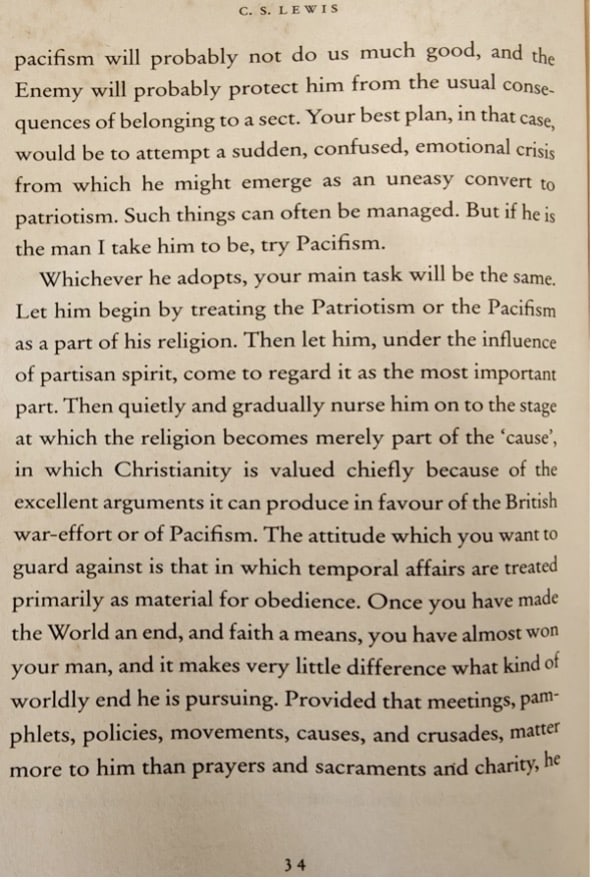
…..pacifism will probably not do us much good, and the Enemy will probably protect him from the usual consequences of belonging to a sect. Your best plan, in that case, would be to attempt a sudden, confused, emotional crisis from which he might emerge as an uneasy convert to patriotism. Such things can often be managed. But if he is the man I take him to be, try Pacifism.
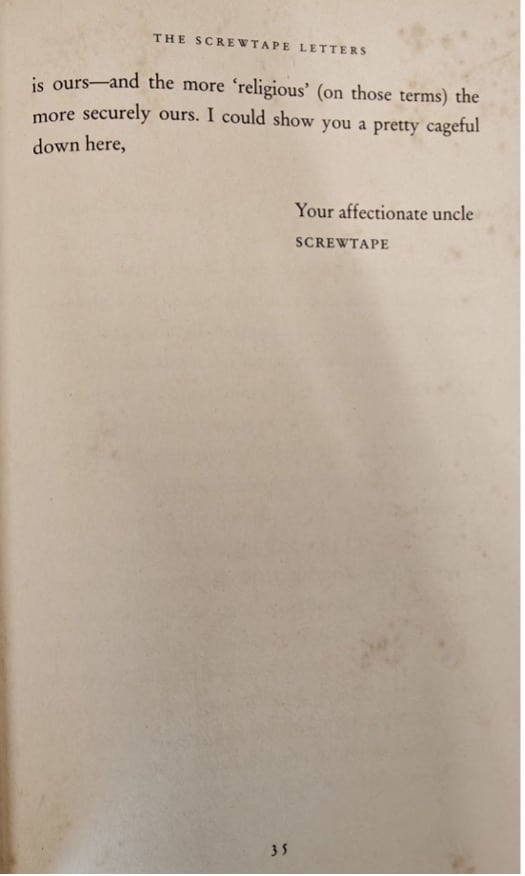
Whichever he adopts, your main task will be the same. Let him begin by treating the Patriotism or the Pacifism as a part of his religion. Then let him, under the influence of partisan spirit, come to regard it as the most important part. Then quietly and gradually nurse him on to the stage at which the religion becomes merely part of the ‘cause’, at which Christianity is valued chiefly because of the excellent arguments it can produce in favour of the British war-effort or of Pacifism. The attitude which you want to guard against is that in which temporal affairs are treated primarily as material for obedience. Once you have made the World an end, and faith a means, you have almost won your man, and it makes very little difference what kind of worldly end he is pursuing. Provided that meetings, pamphlets, policies, movements, causes, and crusades, matter more to him than prayers and sacraments and charity, he is ours—and the more ‘religious’ (on those terms) the more securely ours. I could show you a pretty cageful down here,
Your affectionate uncle
SCREWTAPE